Jensen’s Inequality
Checkout this post to see the background behind this.
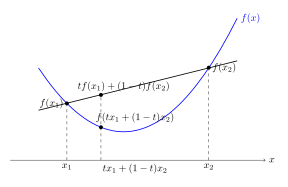
Jensen’s inequality generalizes the statement that the secant line of a convex function lies above the graph of the function1.
\(f:\mathbb R \to \mathbb R\) is convex when,
\[ \forall t \in [0,1], f(tx_1 + (1-t)x_2) \leq tf(x_1)+(1-t)f(x_2) \]
Jensen’s inequality with probability theory
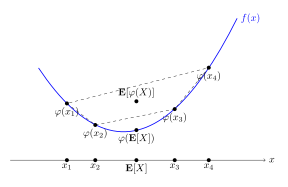
When \(\varphi: \mathbb R \to \mathbb R\) is a convex function,
\[ \begin{align*} \varphi(\mathbb E [X]) &\leq \mathbb E [\varphi(X)] \\[10pt] \varphi \left( \sum p(x_i) \ x_i \right) &\leq \sum p(x_i) \varphi(x_i) \\ \end{align*} \]
Finite form
When \(\varphi: \mathbb R \to \mathbb R\) is a convex function,
\[ \varphi \left( \dfrac{\sum a_i x_i}{\sum a_i} \right) \leq \dfrac{\sum a_i \varphi(x_i)}{\sum a_i} \]
Jensen’s inequality also can be applied under weighted average conditions. Weighted average of \(\varphi(x_i)\) can reside in the dashed quardrangle (including the dashed line).
Examples
\[ \mathrm{Var}[X] = \mathbb E[X^2] - \mathbb E[X]^2 \]
When \(\varphi: x \mapsto x^2\), \(\varphi\) is convex, which makes \(\mathbb E[X]^2 \leq \mathbb E[X^2]\). This is correct because the variance of random variables cannot be negative.